
Types of Brake Discs Explained — Full Guide [2026]

Types of Brake Discs Explained: Solid, Ventilated, Drilled & Slotted — What Actually Matters for Your Application
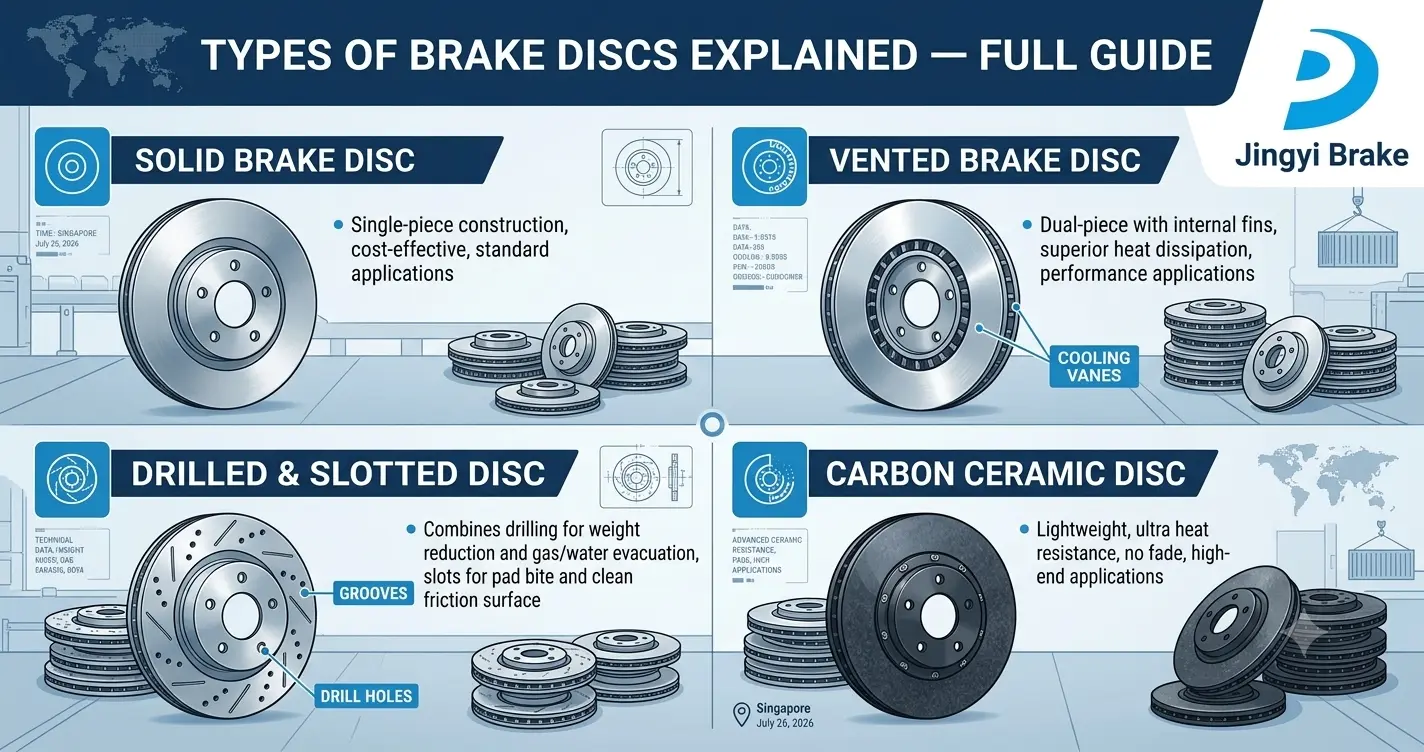
Most buyers ask for "brake discs." Experienced buyers ask for the right brake disc. The difference between those two conversations is exactly what this guide is about.
There are four structural types of brake discs in common use: solid, ventilated, drilled, and slotted — plus a fifth surface treatment category (coated/zinc-plated) that's become impossible to ignore in European and North American markets as of 2025–2026. Each type exists for a specific thermal, mechanical, or commercial reason. Spec the wrong one, and you're looking at accelerated pad wear, premature rotor warping, or — worst case — customer returns that damage your reputation with downstream buyers.
This guide comes from the production and export team at Jingyi Brake, the aftermarket brand of Huangshi Donper Foundry Co., LTD — an IATF 16949-certified brake component manufacturer founded in 1966, with 220,000+ tons annual casting capacity and active supply to distributors across 100+ countries. We manufacture all four disc types across 5,000+ vehicle references. What follows is what we'd tell a distributor walking our factory floor.
Why Brake Disc Type Matters More Than Most Buyers Realize
A brake disc does one thing: it converts kinetic energy into heat through friction with the brake pad. Everything about disc design — geometry, internal structure, surface treatment — is engineered around managing that heat and maintaining consistent friction performance across the operating range of a specific vehicle.
Get the type wrong and the physics work against you. A solid disc on a front axle of a loaded SUV will overheat under repeated hard braking — the friction surface temperature can exceed 600°C in aggressive stop-and-go conditions, causing thermal distortion (warping) and brake fade. A ventilated disc on a lightly loaded rear axle is overkill — it adds cost and weight with no thermal benefit. Drilled discs on a commercial vehicle application will crack at the holes under fatigue loading within months.
I've had distributors come to us after sourcing the wrong type from a previous supplier — not because the quality was bad, but because nobody had the conversation about application requirements upfront. That's fixable. Here's how each type works.
Solid Brake Disc — The Workhorse Rotor
A solid brake disc — also called a plain disc or non-ventilated rotor — is a single-piece flat casting with no internal structure. Both friction faces are part of the same uninterrupted iron mass. Simple, cost-effective, and entirely appropriate for the applications it was designed for.
Where Solid Discs Are Used
Solid discs dominate rear axle applications on most passenger cars and light commercial vehicles. The reasoning is straightforward: on front-engine vehicles with front-biased braking systems, the rear axle typically absorbs only 25–35% of total braking force. Thermal load at the rear is significantly lower. A solid disc dissipates heat adequately at those load levels without requiring the additional mass and manufacturing complexity of internal vanes.
Common applications in our catalog: rear discs for Toyota Corolla (1994–2002), rear fitments for Suzuki SX4, and a range of compact and mid-size European models where rear brake thermal demands are moderate.
What Buyers Should Know About Solid Disc Specifications
Material grade matters here just as much as on ventilated discs. Solid discs produced from SAE J431 Grade G3000 grey cast iron — with a hardness range of 187–241 HB and controlled carbon content — will perform reliably across their service life. Discs cast from inconsistent or lower-grade iron are prone to surface cracking under even moderate thermal cycling.
Thickness tolerance is the other critical spec. Minimum thickness (after wear) is stamped on every disc we produce, and dimensional consistency across a production batch determines whether installers run into lateral runout issues at the first service interval.
Don't assume "solid = entry-level." A correctly specified solid disc on a rear axle will outlast a ventilated disc in the same position — because it's matched to the actual thermal load. The performance gap between a good solid disc and a cheap one shows up in dimensional stability over time, not in dramatic early failure.
Ventilated Brake Disc — Heat Management at the Front Axle
A ventilated brake disc consists of two parallel friction rings connected by a series of internal fins or vanes. As the wheel rotates, air is drawn through the vane channels by centrifugal force, cooling the friction faces from the inside out. The result: significantly lower operating temperatures under repeated or heavy braking compared to a solid disc of equivalent diameter.
How Much Cooler? The Numbers Worth Knowing
According to SAE technical literature on brake thermal management, internal vane ventilation can reduce peak friction surface temperature by 150–200°C under equivalent braking conditions at highway speeds. That reduction directly affects two failure modes: thermal distortion (warping) and brake fade from pad degassing. For front axle applications where braking load concentration is highest, this isn't a performance upgrade — it's an engineering requirement.
Virtually every front-axle brake disc on modern passenger vehicles, SUVs, and light trucks is ventilated as standard. The Lexus IS250 310mm high-carbon disc in our catalog, the Range Rover Sport SVR fitment, the BMW X5 xDrive35i 2013 application — all ventilated. Front-axle thermal loads on these platforms simply exceed what solid construction can safely manage.
Vane Design Variations
Not all ventilated discs are identical internally. Standard pillar-vane designs (straight radial vanes) are the most common and cost-effective. Curved vane and turbine-blade vane designs improve airflow efficiency at the cost of directional specificity — a curved-vane disc is handed (left/right specific), meaning procurement and inventory management becomes more complex. For most aftermarket distribution purposes, straight-vane ventilated discs cover the vast majority of applications without the inventory complexity of handed designs.
Drilled Brake Disc — Wet-Weather Performance and Visual Appeal
Cross-drilled brake discs have through-holes machined across the friction surface in a defined pattern. The original engineering rationale was gas evacuation — early organic brake pad compounds released gases under heat that created a vapor layer between pad and disc, reducing friction. Modern pad compounds have largely eliminated that problem.
So why do drilled discs still exist? Two reasons that remain commercially relevant.
Wet-Weather Bite
The holes give water and debris a path to escape from the pad-disc interface faster than they would on a plain surface. In European markets — particularly the UK, Germany, Benelux, and Scandinavia — drilled discs see consistent aftermarket demand precisely because of wet driving conditions. A distributor in Amsterdam once told me that customers ask for drilled rotors by name based on the visual alone, but they stay loyal because the wet-weather feel is noticeably sharper.
That said — drilled discs are not appropriate for every application. Heavy load cycles, commercial vehicle use, or track/motorsport environments create thermal fatigue stress that concentrates at hole edges. Under sustained high-temperature cycling, this leads to crack propagation from the drill holes. This isn't a quality defect. It's a predictable material response to misapplication.
The Visual Factor. It's Real.
For performance-oriented passenger vehicle aftermarket — particularly in North America, Australia, and parts of the Middle East — the appearance of a drilled rotor behind an open-spoke alloy wheel is a genuine purchase driver. This is not worth dismissing. Retail packaging featuring drilled rotor imagery consistently outperforms plain-disc equivalents in web conversion rates on automotive e-commerce platforms, according to distributor feedback we've collected at Automechanika Frankfurt 2024.
Slotted Brake Disc — Gas Evacuation and Pad Conditioning
Slotted brake discs have machined grooves cut into the friction surface — typically straight, curved, or angled slots running from the inner to outer radius. Unlike drilled discs, there are no stress-concentrating through-holes. That structural difference makes slotted discs significantly more suitable for applications with sustained high braking loads.
What the Slots Actually Do
Three mechanisms are at work:
Gas and debris evacuation — slots channel hot gases and brake dust away from the contact patch, maintaining consistent friction coefficient across the braking event
Pad conditioning — slot edges continuously remove the glazed surface layer from the pad face, keeping the friction material fresh and preventing torque variation
Heat marking — the slots create a visible wear indicator pattern that confirms pad-to-disc contact is occurring uniformly across the full friction face
Slotted rotors are the preferred choice for light commercial vehicles, fleet applications, towing vehicles, and semi-performance passenger cars where braking loads are consistently higher than average but sustained track use isn't the primary scenario. Several fitments in our catalog targeting MAXUS V80 and Mitsubishi Pajero use slotted designs for exactly this reason.
Drilled vs. Slotted: The Short Answer
If a customer asks which is better — drilled or slotted — the honest answer is: it depends on duty cycle. For light-duty passenger vehicles with occasional spirited driving in wet climates: drilled. For commercial applications, towing, or sustained high-load driving: slotted. For customers who want both aesthetics and moderate performance: drilled-and-slotted combination.
One thing I don't recommend: spec'ing drilled discs on a light commercial vehicle application because the customer likes the look. The hole-edge fatigue risk under sustained load cycles is real, and the first crack failure becomes a conversation you'd rather not have.
Coated Brake Discs — The 2025–2026 Market Reality
Coated brake discs aren't a structural type — they're a surface treatment applied to any of the above designs. But given how rapidly demand has shifted since 2023, they deserve their own section.
A coated brake disc has zinc plating or an electrophoretic (e-coat) anti-corrosion treatment applied to all non-friction surfaces — hat section, outer edges, internal vanes, and the back face. The friction rings themselves remain uncoated; the pad beds in and creates its own working surface through normal use.
Why Coated Discs Are Now Non-Negotiable for Many Markets
Two forces are driving this. First, consumer expectations: vehicles are frequently photographed by owners, and a rusty rotor visible through open-spoke alloys generates social media complaints regardless of whether it affects braking performance. Second, regulatory pressure: several European markets and major online retail platforms (including Amazon Automotive EU) now require or strongly preference coated discs for aftermarket listings due to product presentation and shelf-life standards.
According to distributor feedback collected at INA PAACE Automechanika Mexico 2025, coated disc demand in North American and EU channels grew noticeably through 2024–2025, driven primarily by e-commerce channel requirements and fleet procurement specifications requiring corrosion-resistant surface treatment.
At Jingyi Brake, coated variants are available across our ventilated, solid, drilled, and slotted ranges. If you're building a catalog for European or US retail channels in 2026, coated should be your default specification — not an upgrade option.
Quick Comparison: All Types at a Glance
Use this table to match disc type to application requirements. It's a starting point — always verify against OEM specifications and your customer's actual driving profile.
| Disc Type | Construction | Heat Dissipation | Best For | Avoid For | Relative Cost |
|---|---|---|---|---|---|
| Solid | Single-piece casting, no internal structure | Moderate | Rear axles, low-load front axles, compact cars | High-load front axles, heavy vehicles | $ (Lowest) |
| Ventilated | Dual friction rings with internal cooling vanes | High (150–200°C cooler vs. solid) | Front axles on most passenger cars, SUVs, LCVs | Rear low-load axles (unnecessary cost/weight) | $$ |
| Drilled | Ventilated or solid base + through-holes machined | Good (improved wet-weather cooling) | Passenger vehicles, wet climates, performance aftermarket | Commercial vehicles, sustained heavy loads, motorsport | $$$ |
| Slotted | Ventilated or solid base + machined surface grooves | Good (gas/debris evacuation) | LCVs, towing, fleet, semi-performance | Standard light-duty use (slight pad wear increase) | $$$ |
| Drilled + Slotted | Combined holes and grooves on friction surface | Very Good | Performance passenger cars, premium aftermarket, North America/Australia | Commercial/heavy-duty applications | $$$$ |
| Coated | Any of the above + zinc/e-coat on non-friction surfaces | Same as base type | EU retail, US e-commerce, fleet specs requiring corrosion resistance | Budget-tier channels where coating cost premium is unsupported | +$–$$ premium over uncoated |
A few things the table doesn't capture: pad compatibility matters. Slotted discs accelerate pad wear compared to plain surfaces — by roughly 10–15% in standard driving conditions based on field data from fleet operators. Factor that into total cost-of-ownership conversations with your customers. And drilled discs paired with soft organic pads in high-heat applications will show uneven wear at hole edges faster than with semi-metallic or NAO compounds.
How to Spec the Right Brake Disc Type for Your Market
Here's the decision process I'd walk through with any new distributor building out a brake disc catalog for a specific regional market.
Step 1 — Know Your Vehicle Mix
The most common application error comes from not knowing what axle position a disc is going to. Pull the OEM fitment data. Rear-axle references for compact European cars are almost always solid. Front-axle references for SUVs and mid-size sedans are virtually always ventilated. If the OEM specced a ventilated disc, your replacement needs to match — under-speccing to solid to save cost creates a liability problem.
Step 2 — Know Your Channel's Expectations
Selling to a fleet operator in the UAE? Drilled and slotted combination on the front of a Land Cruiser will be flagged as unnecessary cost. Selling to an independent performance shop in Germany? A plain ventilated disc might not even get a second look. Your channel's buyers have expectations shaped by their customers' expectations — and those vary significantly between markets.
In our experience supplying distributors across Europe, the Americas, and the Middle East, the fastest-moving brake disc types by region break down roughly as follows:
Central/Northern Europe: coated ventilated (front) + coated solid (rear) — corrosion resistance is the dominant purchase driver
North America: drilled-and-slotted combination — visual appeal and performance perception drive aftermarket premiums
Middle East / GCC: ventilated (front) in premium vehicles; solid (rear); growing interest in coated for prestige vehicle applications
Southeast Asia / ASEAN: solid and standard ventilated — cost-to-performance ratio dominates; coating adoption is growing but not yet standard
Step 3 — Confirm Material Specification
Regardless of disc type, specify material grade. Grey cast iron to SAE J431 Grade G3000 (187–241 HB) is the aftermarket standard for passenger vehicle brake discs. High-carbon variants — with carbon content above 3.5% — offer improved thermal stability and reduced warping tendency for front-axle high-load applications. Ask your supplier for material composition documentation per production batch. If they can't provide it, that's your answer on quality traceability.
Need help specifying brake disc types for your catalog? Send us your vehicle list or OEM reference numbers — we'll confirm types, fitments, and availability.
Request Fitment Confirmation Browse Full Brake Disc CatalogFrequently Asked Questions About Brake Disc Types
Q: What are the main types of brake discs?
There are four structural types: solid (single-piece, no internal structure), ventilated (dual friction rings with internal cooling vanes), drilled (through-holes on the friction surface), and slotted (machined grooves on the friction surface). A fifth category — coated discs — applies a corrosion-resistant surface treatment to any of the above designs. Each type serves a different thermal management and application requirement.
Q: What is the difference between a solid and a ventilated brake disc?
A solid brake disc is a single-piece iron casting with no internal structure. A ventilated disc has two parallel friction rings connected by internal fins that allow air to circulate and cool the disc during braking — reducing peak friction surface temperature by 150–200°C under equivalent conditions. Ventilated discs are standard on front axles where braking forces and heat generation are highest.
Q: Are drilled brake discs better than slotted brake discs?
Neither is universally better — they serve different needs. Drilled discs improve wet-weather pad bite and are preferred in humid European climates and performance passenger car aftermarket. Slotted discs are structurally stronger under sustained high-load braking (no hole-edge fatigue risk) and better suited for commercial vehicles, towing, and fleet applications. Drilled-and-slotted combination discs offer a middle ground popular in North American and Australian markets.
Q: Can I use a drilled brake disc on a commercial vehicle or van?
Not recommended for sustained high-load applications. Through-holes create stress concentration points in the cast iron. Under repeated heavy braking cycles — typical of commercial vehicle use, towing, or delivery fleet operation — thermal fatigue cracks can propagate from hole edges. For these applications, slotted discs provide improved gas evacuation without the structural compromise.
Q: Why do brake discs rust so quickly after installation — and does coating prevent this?
Grey cast iron oxidizes rapidly when exposed to moisture — surface rust on a new disc can appear within 24–48 hours in humid conditions. This is normal on friction surfaces and wears off with the first few brake applications. Non-friction surfaces (hat, edges, vanes) retain rust permanently on uncoated discs. Zinc-coated or e-coated discs prevent oxidation on non-friction surfaces and are increasingly standard for EU and North American retail channels where product appearance affects buyer confidence.
Q: What material grade should aftermarket brake discs be made from?
Standard aftermarket brake discs are produced from grey cast iron to SAE J431 Grade G3000 specification — with a hardness range of 187–241 HB and controlled silicon and carbon content. High-carbon variants (carbon content above 3.5%) offer improved thermal stability for high-load front-axle applications. Always request material composition documentation from your supplier per production batch as part of quality verification.
Q: How do I know which brake disc type a specific vehicle needs?
Start with the OEM specification: the vehicle manufacturer's original disc type and part number defines the baseline requirement. For aftermarket substitution, match the structural type (solid/ventilated), diameter, thickness, and hat height to OEM dimensions. Upgrading from solid to ventilated on a rear axle is generally not beneficial — it adds cost and weight without thermal advantage. Upgrading from plain to drilled or slotted on the front axle can be offered as a performance option where the vehicle's brake caliper and pad clearances accommodate the change.
Q: Does Jingyi Brake manufacture all brake disc types across its 5,000+ references?
Yes. Jingyi Brake — the aftermarket brand of Huangshi Donper Foundry (IATF 16949 certified, founded 1966) — manufactures solid, ventilated, drilled, slotted, drilled-and-slotted, coated, and wavy-rotor variants. All types are produced on DISA vertical and horizontal automatic molding lines in our two plants in Hubei, China, with full batch traceability and material documentation available per order.
The Takeaway: Type First, Price Second
Brake disc type selection isn't a catalog exercise — it's an engineering decision with safety implications at the end of the supply chain. The right framework:
Solid disc — rear axles, light loads, cost-sensitive markets
Ventilated disc — front axles on virtually all modern passenger vehicles; not optional where OEM spec requires it
Drilled disc — passenger car performance aftermarket, wet climates, visual-premium retail channels; avoid for commercial/heavy-load use
Slotted disc — fleet, commercial, towing, semi-performance; structurally sound under sustained high-load cycling
Coated disc — default specification for EU and North American retail/e-commerce channels as of 2025–2026
Material grade underpins all of it. SAE J431 G3000 grey cast iron with documented composition per batch is the minimum standard for a product that's literally responsible for stopping a vehicle.
At Jingyi Brake, we manufacture the full range — and we're used to helping distributors work through application questions before the purchase order, not after a complaint. If you have a vehicle list you're building coverage for, or a specific market you're trying to serve, send it through. We'll give you straight answers on what fits and what doesn't.
Build Your Brake Disc Catalog with Jingyi Brake
5,000+ references. All disc types. IATF 16949 certified. Factory direct from Huangshi, China.
Contact Julie Zhao to confirm fitments, request samples, or discuss custom packaging options.
WhatsApp / WeChat: +86 13986581697 | Email: zhaoli@donper.com
Julie Zhao
Sales Manager — Huangshi Donper Foundry Co., LTD (Jingyi Brake) | Daye City, Hubei, China
Julie Zhao manages international sales and business development for Jingyi Brake, with over a decade of experience in automotive brake component exports. She has represented Donper Foundry at Automechanika Frankfurt, Dubai, Shanghai, and Moscow, working directly with distributors, fleet procurement teams, and aftermarket importers across Europe, the Americas, the Middle East, and Southeast Asia. She specializes in helping new buyers navigate brake disc specification, fitment verification, and market-appropriate catalog building.
? Related Articles
References & External Sources
SAE International — SAE J431: Automotive Grey Iron Castings: www.sae.org
UNECE — ECE Regulation No. 90: Replacement Brake Lining & Drum Brake Linings: unece.org
IATF Global Oversight — IATF 16949 Automotive Quality Management Standard: www.iatfglobaloversight.org
SAE International — Brake Friction Material and Thermal Management Technical Papers: www.sae.org
MEMA — Motor & Equipment Manufacturers Association, Aftermarket Market Data 2025: www.mema.org